Short answer
Vacation rental website design has one commercial job: make booking direct worth the guest's trouble. Airbnb's published fees define the gap you are working with, and the listing markup you would expect to use in search results turns out to be closed to most operators.
Key takeaways
- 01Under Airbnb's split-fee structure most hosts pay 3% and guests pay 14.1% to 16.5%.
- 02Under the host-only structure most hosts pay 15.5% and guests pay no service fee.
- 03Google's vacation rental markup requires Hotel Center access, not just correct code.
- 04LocalBusiness markup is open to any site and needs only a name and an address.
Start with the arithmetic, not the moodboard
A direct booking site is a cost decision before it is a design one, and the numbers are published. Airbnb operates two fee structures. Under the split fee, most hosts pay 3% and guests pay a service fee of 14.1% to 16.5% on top of the nightly rate. Under the host-only fee, most hosts pay 15.5% and the guest pays nothing extra. Either way, a double-digit percentage of every booking is the budget your own site is competing for.
| Split fee | Host-only fee | |
|---|---|---|
| Host service fee | 3% for most hosts | 15.5% for most hosts |
| Guest service fee | 14.1% to 16.5% | None |
| Brazil and Mexico | 4% host fee | 16% host fee |
The listing markup you probably cannot use
There is a VacationRental structured data type, and most operators cannot use it. Google's own documentation says the instructions are intended for sites that have already connected with a Google Technical Account Manager and have access to Hotel Center; there is an interest form, and filling it in does not guarantee an invitation. Writing the markup correctly is not the barrier — eligibility is.
What is open to everyone is LocalBusiness, where Google asks you to use the most specific subtype available and requires only a name and a postal address. It is far less glamorous and it is the realistic route for an independent property.
Google's photo bar is a useful content bar
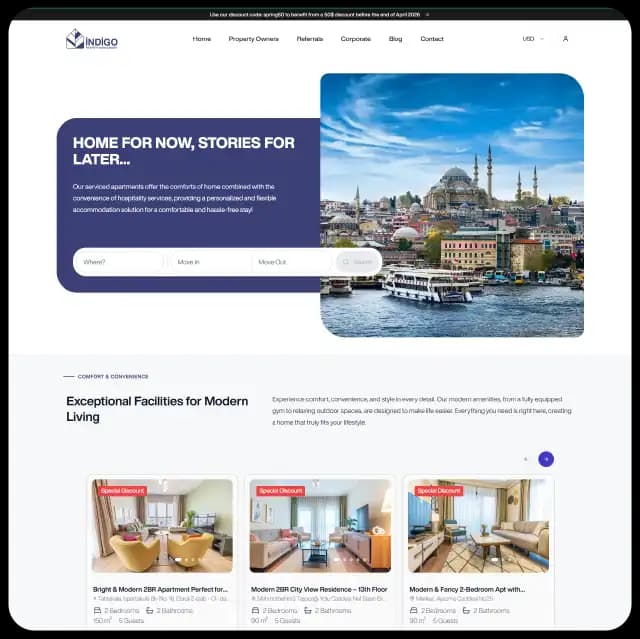
The vacation rental specification is worth reading even if you cannot use it, because it states what a complete listing looks like. It asks for a minimum of eight photographs covering the bedroom, the bathroom and a common area, coordinates given to at least five decimal places, a stable identifier per property, and declared occupancy. That is a content brief, and hitting it makes a direct site look credible next to a platform listing.
The booking flow is the product
A guest arriving from a platform already knows the property is available and what it costs. A direct site that answers neither question in the first screen has given away its only advantage. Availability has to be real and current, the total has to include cleaning and taxes before the payment step, and it has to work on a phone in poor signal — which is what the field thresholds actually measure: LCP under 2.5 seconds, INP of 200ms or less, CLS of 0.1 or less, each at the 75th percentile of real visits.
What to brief, and what to skip
- One property page per listing, with a stable URL that can be linked from anywhere
- A photo set that meets the eight-image bar before launch, not after
- LocalBusiness markup with the most specific subtype, plus name and address
- A calendar synced to whatever platforms you keep, so direct guests never hit a double booking
Skip the parallax hero. It is the calendar and the photographs that decide this. We handle the website build and the photography and content side; see recent work or get in touch.
Frequently asked questions
Usually not. Platforms are a discovery channel and a direct site is a conversion channel. The realistic goal is shifting repeat and referral guests to direct booking, where you keep the fee, rather than replacing platform reach entirely.
Only through Hotel Center, which requires connecting with a Google Technical Account Manager. There is an interest form, but Google states that submitting it is an expression of interest and does not guarantee an invitation.
Treat eight as the floor, covering bedroom, bathroom and a common area, because that is what Google's own vacation rental specification requires. Beyond that, a photograph of the actual view and the actual kitchen beats another styled corner.
Yes, if you want the booking to complete on your site. Sending guests to an email exchange to pay loses most of the advantage you built the site for, and it removes the deposit protection guests expect from a platform.
Stale availability. A guest who requests dates that are already taken rarely comes back to try again. Calendar synchronisation across every channel you list on is the least visible and most important part of the build.
Sources
Keep reading

Restaurant Website Design Is a Margin Decision
Every order routed through a delivery app costs you commission on a 2–6% margin. A restaurant website earns its budget by taking that order directly.
Medical Website Design: What Actually Constrains the Build
Most medical website projects get scoped as a design job and discovered to be a compliance job. Here is what actually binds the build.

Choosing a Website Redesign Company Without Losing Your Traffic
Most redesigns change the design, the URLs, the CMS and the copy in one release. Google's guidance says to do the opposite, and the reason is measurement.





Stop thinking about it.
Start building.
Talk with us — free consultation, no commitments.